
In early 2024 work commenced on the UK's first Net Zero Neighbourhood - a live test of whether a whole place could be decarbonised at once, and whether the model could pay for itself.
Two years and more than 50 retrofitted homes later, Brockmoor has tested far more than the technology. The project revealed the conditions that private investors need before investing, as well as the lessons learnt about data, housing stock, and community trust.
Inside the UK's first Net Zero Neighbourhood
Two years on: Lessons from the UK’s first Net Zero Neighbourhood
What happens when net zero ambitions meet the realities of existing communities? Two years on, Brockmoor is revealing what neighbourhood-scale decarbonisation actually takes.
Can private investment accelerate Net Zero Neighbourhoods in the UK?
Scaling neighbourhood decarbonisation requires more than public funding. Early insights from Brockmoor highlight the conditions private investors need before they are willing to invest.

In partnership with
presents
Select an article to explore
Next page >>
From Pilot to Blueprint


The Brockmoor Energy and Environment Scheme is being delivered by:


On behalf of:

What happens when net zero ambitions meet the realities of existing communities? Two years on, Brockmoor is revealing what neighbourhood-scale decarbonisation actually takes.
Brockmoor – delivered by Equans in partnership with Keele University and Connected Places Catapult on behalf of West Midlands Combined Authority (WMCA) and Dudley Metropolitan Borough Council – has become a live testbed for what happens when net zero ambitions meet the realities of older housing stock, funding pressures and life in existing communities.
Findings from the project, which has now completed its first phase retrofitting more than 50 properties, have already challenged several earlier assumptions.
“The biggest assumption was that you would achieve economies of scale by delivering at a neighbourhood level, because you would be mobilising one delivery team across one or two streets, rather than delivering the same number of houses spread across a much wider area,” says Eleanor Pitcher, Head of Energy Innovation at Equans.
Instead, the learning has been that larger-scale delivery works much better from a cost perspective, Pitcher says.
The project also exposed a wider challenge facing retrofit programmes: the quality of existing housing data. Several homes initially classified as EPC C were found to be performing significantly below expectations once monitoring equipment was installed.
After installing monitoring equipment to measure temperature, relative humidity and electricity consumption, the data showed some of the properties weren't performing as EPC C homes should, says Pitcher.
Additionally, when the team carried out structural surveys for the solar installations, many of the roofs weren't structurally capable of supporting the panels, which meant an extensive programme of roof repairs and roof replacements had to be undertaken.
Two years on:
Lessons from the UK’s first
Two years after work commencing on the UK’s first Net Zero Neighbourhood, Brockmoor is showing that neighbourhood decarbonisation is as much about data, community trust and housing conditions as it is about technology. The pilot project has revealed unexpected challenges around EPC ratings, roof suitability and resident engagement, while also providing real-world lessons about how to provide scale in the UK decarbonisation retrofit sector.

What did prove true, however, was the value of a community-led approach. By having people based in the neighbourhood as local points of contact throughout the project, Equans and its partners were able to engage with far more residents than they otherwise would have.
“One of our recommendations going forward is that the community or resident engagement model can't really be scaled. It needs to be replicated, which means that these representatives will be different depending on the location,” says Pitcher.
This has been a major lesson Equans and its partners are taking away from the project – the importance of having that local voice and being on the ground, adds Andrew Spencer, Energy and Carbon Services Director at Equans.
For Brockmoor specifically this means that, moving into phase two of the project, Dudley Council is putting in a more permanent site office because they've recognised the value of having that local presence, says Pitcher.
Going forward, understanding the scope of the project much earlier is important, and that comes through better data and stronger engagement from the very beginning, adds Spencer.
One of the key learnings from Dudley has also been understanding the different revenue streams and how they can support the investment model, according to Spencer. One example is Levelise which was deployed in the first phase of the project - it optimises energy usage: charging low, avoiding highs, and participating in flexibility markets when it pays - this delivers resident savings and revenues.
Alongside reducing emissions, the project has explored the new revenue streams from locally generated energy, lowering residents' energy costs and support wider regeneration. In the second phase of the project Dudley are exploring a revenue sharing model with Levelise to invest back into further decarbonisation works.
Going forward, there is a significant drive towards large-scale rooftop solar deployment in the UK, says Pitcher.
“For us, one of the biggest lessons from Brockmoor, and from place-based projects generally, is the importance of understanding the scale and volume as early as possible,” says Spencer, adding that this makes it easier to bring in investment and align everything from the outset.
Because this was an innovation project, it evolved continuously. And from a private investment sector perspective, which values certainty and risk reduction, this creates additional uncertainty.
Going forward, understanding the scope of the project much earlier is important, and that comes through better data and stronger engagement from the very beginning, adds Spencer.
"Some of the lessons the Brockmoor project delivered around solar are now informing the creation of dedicated SPVs for solar and battery storage"

Not what it seemed
Read more on the Equans UK & Ireland website
Learn more
<< Previous page
Next page >>
Net Zero Neighbourhood
What is a Net Zero Neighbourhood (NZN)?
A Net Zero Neighbourhood (NZN) is a place-based approach to decarbonisation that transforms homes, infrastructure, and communities to dramatically reduce carbon emissions while improving quality of life. It integrates low-carbon technologies with smart energy systems, sustainable transport, and green spaces to create a resilient, future-ready local environment.
"One of our recommendations going forward is that the community or resident engagement model can't really be scaled. It needs to be replicated"
Eleanor Pitcher,
Andrew Spencer
Head of Energy Innovation, Equans
Energy and Carbon Services Director, Equans


Some of the lessons the Brockmoor project delivered around solar are now informing the creation of dedicated SPVs for solar and battery storage. Those will then link into smart grids, Warm Homes funding through devolution, and other programmes, says Spencer.
The aim is to bring together multiple smaller solar and battery projects into a single investment vehicle, creating the scale and consistency needed to attract long-term private capital, according to Spencer. Rather than funding individual schemes in isolation, the model allows assets across housing portfolios and public estates to be aggregated, providing a more repeatable approach to financing local energy infrastructure.
The model also reflects a shift towards viewing rooftop solar as part of a wider local energy system rather than a standalone technology, says Spencer. By combining solar generation with battery storage and smart energy management, projects can not only reduce residents' energy costs but also participate in flexibility markets. This can help create additional revenue streams that can support future decarbonisation investment, he says.
There's also a lot of work taking place, including within Equans, around the private investment model, particularly for privately owned homes, according to Pitcher.
The focus is on developing cost recovery mechanisms so that residents don't have to pay the upfront cost of the work. That means investors need a practical way of recovering their investment over time. The challenge now is identifying which mechanisms are the most effective and practical, says Pitcher.
As more towns and cities pursue place-based net zero strategies — in the UK and beyond — Brockmoor is exposing what neighbourhood decarbonisation at scale actually requires. Those lessons may prove just as valuable as the technology itself.

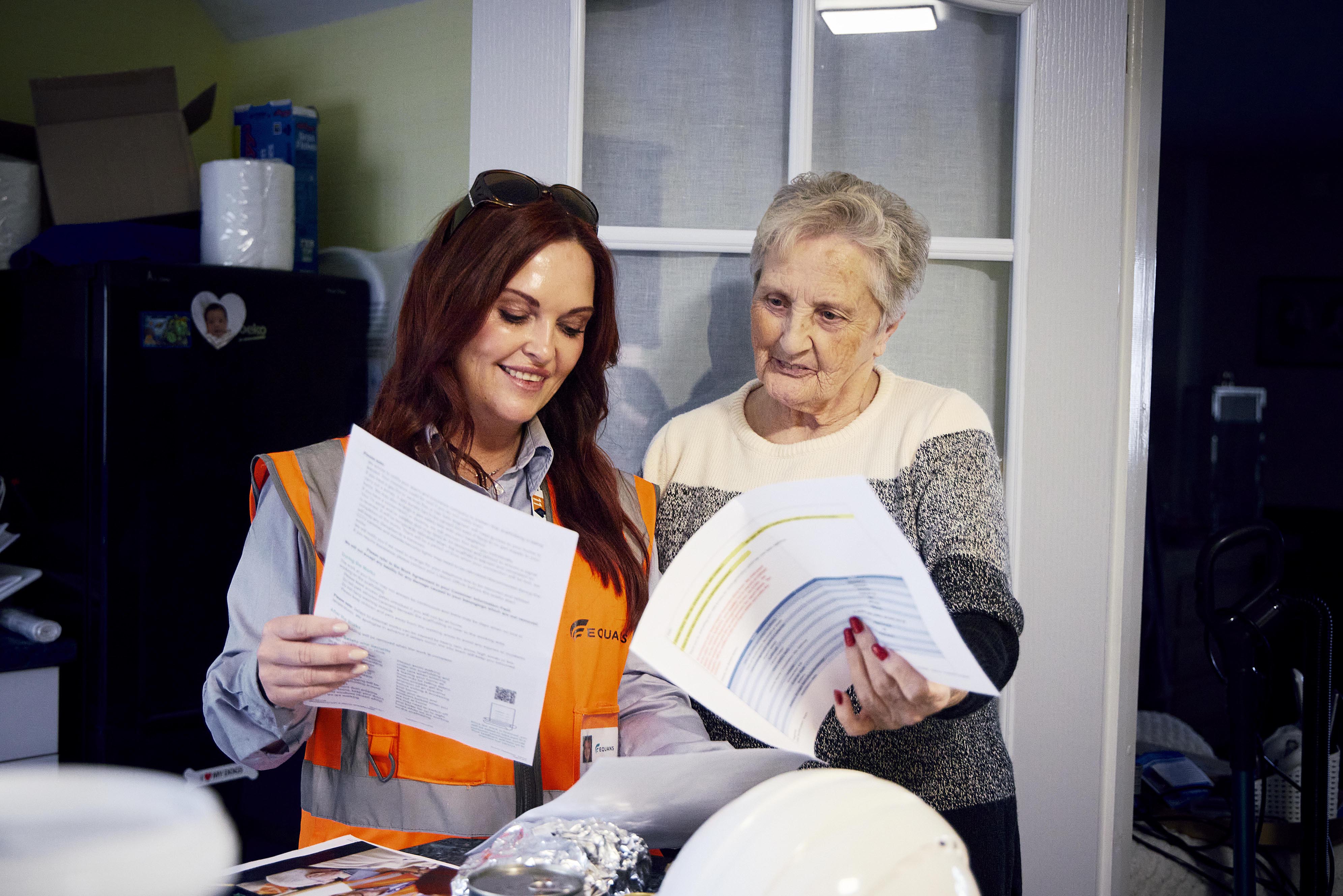
The project has seen regular pop-up consultations including in Brockmoor Park to engage with the local community.
BEES = Brockmoor Energy and Environment Scheme.
Roof repairs under way to allow for solar panel installation.
The project aims to lower residents' energy costs and reduce emissions while supporting wider regeneration.
In the UK, the technology needed to decarbonise neighbourhoods already exists. However, numerous challenges often arise, the biggest of which is financing deployment at scale.
Even in 2026, neighbourhood decarbonisation projects still often depend on grants and government support to get off the ground. The question is whether they can evolve into commercially viable models capable of attracting long-term private investment.
Brockmoor in Dudley is one of the UK's first attempts to design a neighbourhood decarbonisation programme with that goal in mind.
Work commenced in early 2024 by an Equans-led consortium on behalf of West Midlands Combined Authority (WMCA) and Dudley Metropolitan Borough Council on the UK’s first Net Zero Neighbourhood (NZN) - offering a glimpse into how the UK could begin scaling neighbourhood decarbonisation beyond pilot schemes and public funding.
Through the pioneering NZN project Equans, Keele University, and Connected Places Catapult are delivering a place-based decarbonisation strategy that focuses on transforming homes, infrastructure, and communities. This approach enhances energy efficiency by retrofitting housing to create comfortable living spaces while boosting community resilience through renewable energy generation, battery storage, and smart energy management. The project also supports neighbourhood regeneration and the development of green spaces, alongside promoting low-carbon mobility and active travel infrastructure.
Can private investment accelerate
Scaling neighbourhood decarbonisation requires more than public funding. Early insights from Brockmoor highlight the conditions private investors need before they are willing to invest.


Crucially, these diverse interventions are driven through community co-production and collaborative design, creating a resilient, future-ready local environment.
“This project was not just about testing new technology; it was a test bed for attracting private capital," says Andrew Spencer, Energy and Carbon Services Director at Equans.
Through a blended-finance approach including initial grant funding from the WMCA, the project unlocked £3.53m for the retrofit of more than 50 homes in phase 1 and helped to provide insights into how future Net Zero Neighbourhoods can attract institutional private capital – the type of long-term finance needed to support large-scale neighbourhood roll-out. WMCA are now looking at establishing a private capital fund that can be deployed at scale for retrofit.
“That's one of the major outcomes of the [Brockmoor] project. The WMCA are now looking at deploying billions of pounds into this area, through bringing together funding from the Department for Energy Security and Net Zero, the UK Treasury and private capital into a blended funding model,” says Spencer.
What private investors want
Brockmoor is already offering some clues about what private investors need to see before deploying capital into Net Zero Neighbourhood projects.
De-risking is a major factor for private investors, according to Spencer. They want transparency and clarity over where responsibility sits, and that's something the team behind the project built in through an outcomes-based approach.
Some measures are captured at project level — for example by Dudley Council — while others are measured at portfolio level, where responsibility sits with WMCA. That clear allocation of responsibility is an important part of de-risking for investors, Spencer says.
Clear, evidence-based returns also matter. Investors want scalability and replicability — the ability to roll the model out at volume, Spencer says. To do that, you need standardised delivery frameworks that can support large-scale deployment.
Most of the funding in this space is impact-led, so investors also need measurable KPIs demonstrating that the work is contributing to the intended outcomes, says Spencer. These include metrics such as carbon reduction, energy bill savings, asset performance, resident engagement, and health co-benefits.
While Government at all levels are moving towards outcome-based investing and project design, reporting frameworks have traditionally focused on outputs such as number of homes retrofitted without capturing wider benefits such as enhanced community wellbeing. To address this challenge, Equans’ Net Zero Neighbourhood logic model provides a comprehensive monitoring and evaluation framework to connect local interventions directly to regional and national outcomes – data which supports robust investment cases for both public and private financial support.
“The logic model is applied alongside the retrofit programme, supported by a monitoring and verification framework so you can track progress towards the achievement of intended outcomes, as well as understanding how implementation impacts the efficacy of interventions,” he says.
Contract length and cash flow are another consideration, he adds. “Some of the work we've been doing with the West Midlands Combined Authority has focused on how to attract investment into the region. That requires longer-term contracts, so the private sector has time to recover its investment,” he says.
“Investors want transparency over where responsibility sits, and that's something the team behind the project built in through an outcomes-based approach”
Learn more
<< Previous page
Net Zero Neighbourhoods
in the UK?
Policy and regulation will play a central role in determining whether neighbourhood decarbonisation can be delivered at scale. A lot of the needed policy changes in the UK are already starting to happen, Spencer says.
For WMCA, one of the biggest drivers is devolution. It's not just about having greater powers; it's also about having the funding that previously sat within national programmes, he explains.
Brockmoor reflects that change, with an overall £3.53m budget including £1.65m from WMCA for phase 1 and the remainder through a range of different grant programmes.
Policy as a catalyst for investment
“Policies such as the Warm Homes Plan, the Minimum Energy Efficiency Standards and the Decent Homes Standard are starting to become much more integrated, which is positive”
Alongside this, national policies such as the Warm Homes Plan, the Minimum Energy Efficiency Standards (MEES) and the Decent Homes Standard are starting to become much more integrated, which is really positive, says Spencer.
The Warm Homes Plan is intended to accelerate energy efficiency improvements through public investment, while MEES sets minimum EPC requirements for rented properties and the Decent Homes Standard establishes baseline expectations for the quality and condition of social housing. Together, they are helping to create a more joined-up policy framework for retrofit and decarbonisation.
“What we now need is consistent implementation and enforcement. There needs to be both the incentive and the regulatory driver to encourage the market to move,” says Spencer.
Spencer hopes these policy changes will help move neighbourhood decarbonisation beyond reliance on one-off grants and towards blended finance models capable of attracting institutional capital. If that happens, projects like Brockmoor will move beyond being an innovation project and become a blueprint.
Read more on the Equans UK & Ireland website
Andrew Spencer
Energy and Carbon Services Director, Equans


A Brockmoor resident with newly installed air source heat pump.
Outline of the Brockmoor Net Zero Neighbourhood within the wider area.

The Brockmoor Net Zero Neighbourhood Showhome, which was visited by the community to see a whole-house retrofit in action, including heat pump, battery, solar PV and Mechanical Ventilation & Heat Recovery system.