
From ambition to action
As expectations around disclosure and environmental claims rise, businesses need strategies to reduce their carbon footprint that offer measurable outcomes – and this means identifying quality carbon credits, with clearly defined objectives and verifiable outcomes, backed by robust reporting.
Ecologi’s Reduce, Restore, Report methodology provides a clear structure: prioritise decarbonisation, support verified climate and nature solutions for residual emissions, and demonstrate progress with a transparent audit trail.
The aim of the 3Rs is simple – clearer decisions, stronger documentation, and more impactful corporate climate action.
Effective climate action calls for focused governance, data-driven investment decisions, and verifiable impact.

The 3Rs: A framework for effective climate action
The UK has one of the best records in emissions reduction of any developed economy, cutting territorial greenhouse-gas emissions by around 54% since 1990
Ensuring quality in carbon credits
Voluntary carbon credits can play a valuable role in directing private capital to high-impact climate and nature projects – supporting the global push to net zero
In partnership with

presents

Select an article to explore more.


“Corporate climate strategies are often disjointed, complex and with varying degrees of stakeholder buy-in – the 3Rs framework distils the important steps”
Navigating climate change:


scroll

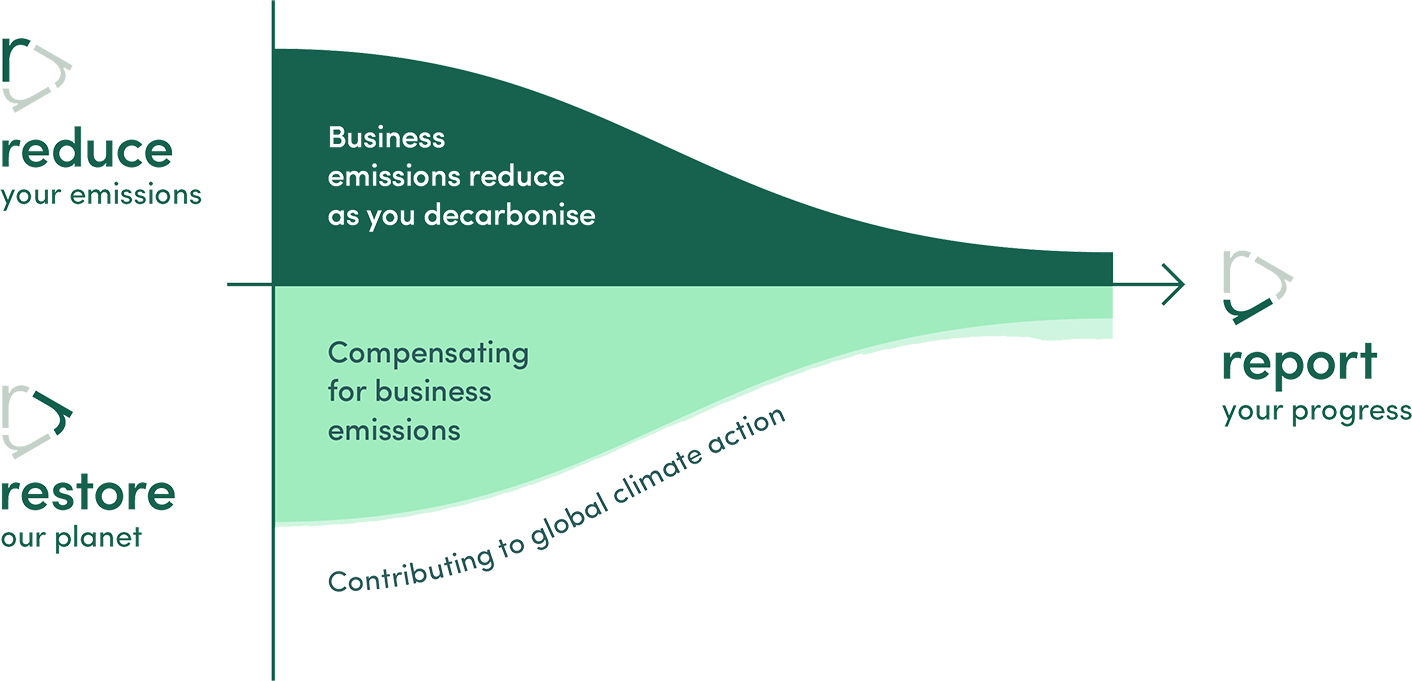
The ‘Reduce’ pillar starts with measurement: establishing a robust baseline across Scopes 1, 2 and 3 and pinpointing the biggest sources of emissions. The emphasis is on a workable approach to Scope 3 – where the majority of most companies’ footprint sits – using GHG Protocol-aligned methods and, where relevant, sector-endorsed protocols. From there it moves to target-setting, including SBTi-aligned short- and long-term goals, and the practical work of delivery: acting on reduction strategies that translate targets into measurable progress.
Done well, the ‘Reduce’ pillar can have a positive effect on performance as well as emissions, improving operational efficiency, cutting costs and strengthening competitiveness.
Reduce
The 3Rs: A framework for effective climate action



scroll
previous page
NEXT page
A three-step framework
But more needs to be done for the country to be net zero by 2050.
Businesses play a key role because the biggest impact on emissions is commerce: what gets financed, built, bought and operated, and how supply chains are managed.
Effective corporate climate action calls for clear, sector-specific pathways and each business needs a reliable way of assessing and reporting its environmental impact.
“Done well, the ‘Reduce’ pillar can have a positive effect on performance as well as emissions”
Report
The ‘Report’ pillar is about evidence: disclosure of progress against targets, and transparency on any carbon-credit purchasing and retirement, and how it fits within the broader measurement and reduction plan.
“For larger businesses there are regulatory requirements for greenhouse gas inventory disclosures and reporting - but we see this as vitally important for small-to-medium sized businesses as well – who are likely to be obligated to measure and disclose their impacts on climate and nature in the near future," says Jackson.
That means reporting that can be checked – by auditors, procurement teams, investors and regulators – and that is specific about what has been reduced, what remains, and what climate finance is being used to do.
Environmental statements must be fully substantiated, and high-integrity practice is increasingly shaped by guidance such as the CMA’s Green Claims Code and the VCMI Claims Code of Practice – both pushing companies towards accountability and transparency about outcomes and placing limitations on the kinds and quality of credits which can be credibly used for different claims.
“A key tenet of corporate sustainability is transparency,” says Jackson. “But as well as falling into non-compliance, businesses who do not adequately or accurately report on their climate progress risk letting stakeholders down which could produce barriers to investment, increased insurance premiums, and loss of customer confidence.”
For sustainability teams, the 3Rs framework helps turn a net-zero ambition into an operating model: a clear reduction plan, a defensible approach to what remains, and reporting that can be evidenced.
“Corporate climate strategies are often disjointed, complex and with varying degrees of stakeholder buy-in,” says Jackson. “The 3Rs framework distils the important steps – offering businesses a framework which helps embed climate action at the heart of their operations and take real action that complies with existing sustainability best practice.”
The UK has one of the best records in emissions reduction of any developed economy, cutting territorial greenhouse-gas emissions by around 54% since 1990.
Restore
The ‘Restore’ pillar covers what remains while decarbonisation programmes scale. It focuses on taking responsibility for unabated emissions in the near term by funding verified carbon projects including carbon removal, as well as broader kinds of climate action and nature recovery programmes.
Carbon credits are framed as a complement to reductions, not a substitute, and sit after direct cuts in the mitigation hierarchy. The Restore pillar also keeps an important distinction clear: compensating for emissions in a reporting year is not the same as neutralising residual emissions at the end of a net-zero pathway.
In Ecologi’s methodology, quality is treated as non-negotiable. The approach uses established tests – additionality, permanence, robust quantification and baselines, safeguards against double counting, leakage controls, and independent validation and monitoring – while recognising how projects can underperform in the real world, from weak governance to resilience against climate-driven shocks such as drought and wildfire.
“Compensating for emissions in a reporting year is not the same as neutralising residual emissions at the end of
a net-zero pathway”
Ecologi’s 3Rs methodology structures climate action into three continuous steps: reduce emissions, restore the planet and report progress.
The 3Rs provide a framework for building an effective climate strategy – adaptable for different businesses and sectors. The methodology is aligned with established climate standards and net-zero guidance:
Greenhouse Gas Protocol (GHGP)
Science Based Targets initiative (SBTi)
Oxford Principles for Net Zero Aligned Carbon Offsetting


“Effective corporate climate action calls for clear, sector-specific pathways”


“Having a framework like the 3Rs helps businesses to make sense of the huge number of acronyms and standards that exist in corporate sustainability,” says Sam Jackson, Director of Climate Science & Impact at Ecologi. “Synthesising best practice from a range of sources, the 3Rs framework provides a simple, understandable ladder to climb – allowing businesses to take the right steps towards meaningful climate action.”
But whether addressing residual emissions or supporting wider net-zero goals, quality matters – and buyers need to be confident that their credits meet the standard and are appropriate for their climate ambitions.
“Investing in carbon projects is a crucial tool in the fight against climate change,” says Lucy Gemmell, Carbon Portfolio Manager at Ecologi. “But the impact depends on the quality of the credits – every tonne avoided or removed must be real, which makes rigorous due diligence non-negotiable.”
The following case studies show how Ecologi applies its Carbon Projects Assessment Framework (CPAF) to help organisations across various sectors measure the impact, risks and integrity of carbon projects.

previous page
homepage
Across all three programmes, the goal wasn’t simply to fund ‘good projects’, but to ensure climate finance could stand up scrutiny – from internal governance and assurance through to stakeholder expectations and public reporting.
This means having a clear, evidence-led rationale: why these projects were selected, how delivery risks were assessed, and how the impact of the projects will be evidenced moving forward.
Ecologi’s portfolio of projects are a combination of avoidance and removal projects, all of which scored above 80/100 across the three pillars – Climate, Nature, and People – under our internal carbon project assessment framework. These high scores reflect strong overall performance against our due diligence criteria, demonstrating robust environmental integrity, positive nature impact, and meaningful community benefits.
Our CPAF is intended to make those objectives repeatable at scale, by applying a structured quality and risk screening to project selection, rather than relying on generic labels or registry claims alone.
“Our approach to selecting high-quality carbon credits is grounded in a fully quantitative methodology - continuously strengthening our project assessment framework, working with leading data partners, and demonstrating that the projects we support are among the highest quality available on the voluntary carbon market,” adds Gemmell.
Voluntary carbon credits can play a valuable role in directing private capital to high-impact climate and nature projects – supporting the global push to net zero.
“Within our team, in-house risk engineers work alongside underwriting and claims specialists to ensure we have a rapid grasp and insight into new technologies and their operational risks”


Case Study 1
University of Derby
The University of Derby set out to deliver “net-zero carbon construction” for its new Cavendish Building (Derby International Business School) in line with UK Green Building Council guidance.
The university embedded an internal carbon fee of £70/tCO2e at project proposal stage (2021) to drive early design and procurement decisions, prioritising reductions through lower-carbon materials and construction methods.
Residual embodied emissions of 6,652 tCO2e were then addressed via a high-integrity carbon portfolio aligned to the Oxford Principles, with a 55/45 split between removals and avoidance.
Remaining budget supported a Transition Fund, including peatland restoration in Derbyshire’s Goyt Valley after April 2025 wildfires. Reported outcomes include 2.9k tCO2 avoided, 3.6k tCO2 removed, and 20k m² habitat restored.

Case Study 2
Midcounties Co-operative
The Midcounties Co-operative (Your Co-op) wanted to translate an already complex, multi-division climate strategy into customer-facing action that would meet member expectations and stand up to scrutiny.
After completing a detailed Scope 1–3 footprint with EcoAct in 2022, the organisation set reduction goals tied to sustainability-linked finance and a public commitment to cut direct GHG emissions by 50%, with near-term SBTi-validated targets. It then exceeded its 2023/24 goal (vs 2019) by achieving 32% emissions reductions—driven largely by store energy-efficiency investments such as refrigeration upgrades, automation and LED lighting—alongside support for community renewable energy initiatives.
In parallel, Your Co-op embedded climate impact into its broadband and mobile propositions by funding monthly carbon avoidance (with a margin of error) and tree planting, plus a tree per Co-op Holiday booking and a Million Tree Pledge (Dec 2022).
Since 2021, it has funded 157,046 trees, avoided 4,721 tCO2e, and supported 50 projects, strengthening brand reputation, attracting younger customers and helping maintain low churn in utilities.

Case Study 3
Mulberry
Mulberry, the UK’s largest luxury leather-goods maker, set out to turn its ‘Made to Last Manifesto’ into measurable progress: transition to a regenerative, circular model by 2030 and reach net-zero by 2035.
After building a robust emissions baseline with the Carbon Trust and aligning with SBTi’s FLAG guidance (2022), the company accelerated operational decarbonisation—reporting a 9.5% reduction in UK scope 1–2 emissions to April 2024 and installing a 360kW solar PV array at its Somerset factory expected to supply over 60% of site electricity annually.
To embed engagement across a its global workforce, Mulberry paired internal communications with practical mechanisms: a ‘welcome’ tree for every new starter, ongoing tree planting to mark milestones, and quarterly measurement and balancing of business-flight emissions through carbon avoidance projects, alongside a stricter travel policy.
Since 2022, Mulberry has funded 1,300 trees and avoided 568 tCO2e, while HR reports sustainability is raised by nearly every job candidate; the programme also earned an Ecologi For Our Planet Award (April 2024).

CPAF
Ecologi’s Carbon Project Assessment Framework (CPAF) is an assessment framework designed to help screen the quality of carbon credit projects.
The assessment has three levels:
The carbon standard issuing the credits is assessed against criteria such as transparency, governance and independence
The methodology used to calculate the claimed carbon impact
The project itself is assessed for benefits, risks and ongoing performance
Projects are scored across Climate, Nature and People, with scores adjusted where outcomes are less certain or more exposed to risks such as reversal.
Only projects that meet CPAF’s minimum scoring thresholds are eligible for inclusion, supporting more consistent project selection and clearer reporting.


“Buyers need to be confident that their credits meet the standard and are appropriate for their climate ambitions”
“Our CPAF is intended to make [climate] objectives repeatable at scale, by applying a structured quality and risk screening to project selection”
Read our report to find out more about about CPAF
Ensuring quality in carbon credits
scroll